


By Violet Auma || violetmedia8@gmail.com
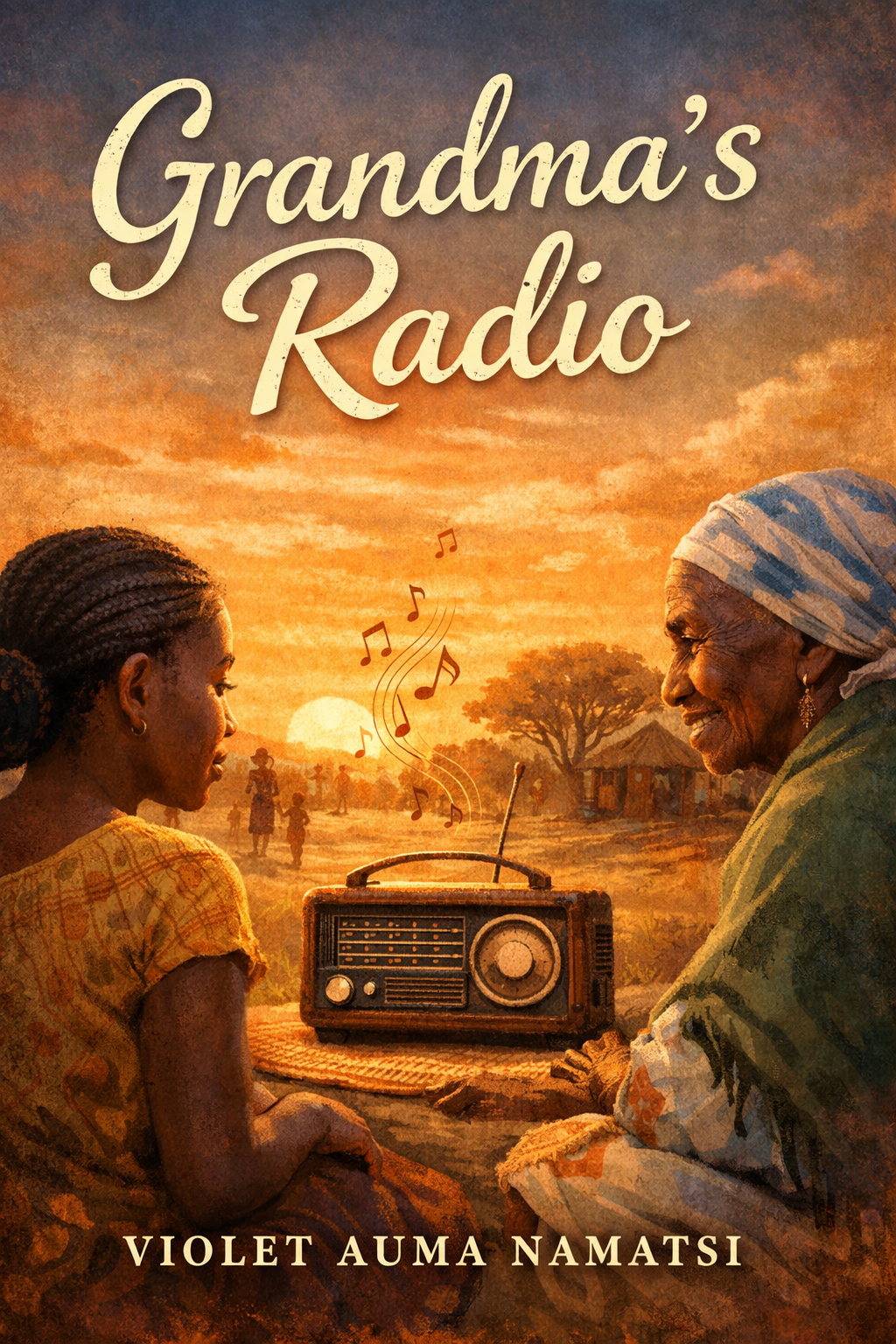
My name is Violet Auma Namatsi, and my story begins in a village where mornings smelled of wet soil and evenings carried the soft crackle of a radio. Long before I understood what journalism was, I knew the power of a voice traveling through the air. I knew it because of my late grandmother, Mwajuma—the woman I am named after.
She is gone now, but in quiet moments, I feel her. When the radio hums, when the wind rustles through mango trees, I hear her whisper in my memory, guiding me.
As a child, school holidays meant long walks to her house, where life moved to the rhythm of the radio. Grandma Mwajuma loved the radio the way some people love prayer.
In the morning, it played as she prepared for the day. In the afternoon, she carried it to the farm, resting it on the grass as she worked. At night, it sat beside her bed, and we listened together until sleep overtook us. Sometimes we laughed, sometimes we debated the voices speaking from far away, sometimes we simply sat, hearts leaning toward the unseen storytellers.
Those were gentle days. I did not know then that they were shaping my future. It was there, beside her, that my dream was born.
I was in Standard Seven when that dream became clear. Listening to voices like Elizabeth Obege and Amina Faki, I did not just admire them—I recognized myself in them. I imagined my own voice flowing through the same airwaves, telling stories that mattered, stories that would reach women like my grandmother in quiet corners of the country.
That promise stayed with me, through school, through doubt, through fear. And one day, it came true. She lived long enough to hear me.
When my first reports aired, Grandma Mwajuma listened attentively. After every story, she would call me, asking questions only someone who truly cared would ask. If I reported an accident, she wanted to know how the injured were doing. Were they recovering? Had they gone home?
Through her questions, she taught me that journalism was not just about reporting events, but about following the human story beyond the headline.
In 2013, fresh from school, my career began with energy and hope. I secured a job at one of the leading media stations in the country, as a reporter for a vernacular radio station.
I was overwhelmed with joy—not just because I had a job, but because it was the very station my grandmother had loved. I was speaking directly to her world now.
The sun rose over red soil and maize stalks. Chickens scattered, dust rose, and smoke curled from cooking fires. Women drew water from the well, balancing buckets on their heads. Somewhere, a radio hummed faintly.
I imagined Grandma Mwajuma sitting in her doorway, listening. Her eyes followed the world around her, but her heart listened to the voices in the air. That is where I learned to listen, too.
As a field reporter, I covered everything: breaking news, politics, accidents, community struggles, celebrations. But slowly, I found myself drawn to stories many others avoided: science, health, and climate change.
Stories considered boring or unimportant by some, yet deeply lived by people in the village. I saw science in the long walks to clinics, health in the coughs that filled dusty homes, and climate change in rivers that shrank and rains that no longer kept time.
I was an African woman in the village, telling African science stories in the village. And it was not easy. Being a woman meant being questioned before being heard. Doors closed faster, voices rose over mine, doubt shadowed my facts.
Some days felt heavier than others, and survival meant choosing courage over comfort. There were moments I almost stopped—when funding disappeared, when stories were shelved, when silence felt safer than truth. But I stayed, because the village needed these stories told in a language it understood.
The sun beat down as I walked along a narrow dirt path. Children ran ahead, their laughter echoing through the maize fields. Women carried water and firewood, pausing to wave at me. At the clinic, I listened to nurses talk about patients with malaria, mothers worried about their children, and elders wondering why the rains had not come.
I scribbled notes, imagining my grandmother listening in, asking questions about every detail, every life behind the numbers.

At the radio station, I began producing feature stories—long, thoughtful pieces many reporters avoided. Those stories opened new doors. I was soon allowed to report not just for vernacular radio, but for national Swahili radio as well.
I remember that joy clearly, the feeling that my voice was growing, stretching beyond the village without losing its roots. My first award came from a health story, and even in my grandmother’s absence, I felt her pride. I felt seen. Encouraged. Certain that I was on the right path.
My grandmother Mwajuma died in August 2017, and I miss her deeply. I miss the days of listening together, laughing, and sharing meals. Sometimes, when I am alone, I imagine her sitting beside me again, the radio between us, her eyes alert, her heart open. Grief has not erased her voice; it has woven itself into my work.
Challenges followed me closely. Many times, my story ideas would be approved, only for editors to send TV crews from Nairobi to redo the same stories. Radio and TV would air together, but TV often took the credit. It happened again and again, until I knew I had to change my story.
When I heard a local photographer was selling his camera for eighty thousand shillings, my heart sank. I did not have the money—not even close. Still, I asked. We agreed I would pay in installments, and I took the camera in my hands like a fragile promise. That was the beginning of my television journey.
In the dusty heat of the afternoon, I crouched beside a farmer as he measured the shriveled edges of his maize field. “The rains came late this year,” he said, shaking his head. I recorded his voice, watching the worry crease his forehead.
I thought of the rivers that had run full last decade, now mere trickles. I imagined Grandma Mwajuma listening, asking me if the children were still eating, if the mothers were well, if anyone had gone hungry.
I was now reporting for vernacular radio, national Swahili radio, and producing my own TV features. I shot, scripted, and sent my stories myself. None were rejected. Every one aired. And without realizing it, I was saving the company money too—no more Nairobi crews needed.
As my storytelling grew, so did opportunities. I attended trainings organized by the Media Council of Kenya, MESHA, AMWIK, JHPIEGO, and others. At one MESHA training in Nairobi, my life almost ended. A fire broke out in the hotel at night.
I was sleeping on the fifth floor. The power was cut, and my phone was on silent. Colleagues called and knocked, but I did not wake. Only when smoke began choking me did I open my eyes. In the darkness, struggling to breathe, I searched desperately for my keys. By the time I found them, the smoke was thicker.
I could not walk. I could not breathe. When the door finally opened, people helped carry me downstairs. I collapsed and was rushed to hospital, placed on oxygen. I survived.

We were moved to another hotel, and the training continued. That night changed me. It reminded me how fragile life is, and how urgent these stories are.
I walked through the schoolyard, children chasing one another across cracked dusty fields, their worn shoes kicking dust into the sun. Teachers talked about handwashing, nutrition, malaria prevention.
I recorded every voice, every detail, turning it into a story the world could hear. I imagined Grandma Mwajuma smiling at me, proud that I had grown into the listener and teller she had raised me to be.
Today, I look back and see survival woven through my journey. I have faced fear, rejection, exhaustion, and risk. I have also collected beautiful memories—moments of recognition, impact, and honor. I have won awards for my work in health, gender, and family planning. Each one reminds me that the stories I once loved quietly are now being heard loudly.
Evening falls, painting the river red and gold. Children kick a tattered ball across dusty ground, their laughter echoing. Smoke from cooking fires drifts over the village. Somewhere, the radio hums—a story of life far away.
I imagine Grandma Mwajuma, smiling, shaking her head at the news, asking questions that only a heart that cares could ask. I carry her spirit in my footsteps.
I am still that village girl who listened to the radio beside her grandmother. I am still telling stories meant to save lives, empower women, and explain the changing world around us. I translate science into human experience. I turn climate change into faces, voices, and footsteps on dry land.
My grandmother Mwajuma is late now. I miss her, but she walks with me in every story I tell. Every time my voice goes on air, I imagine her listening somewhere, smiling, asking questions, wanting to know what happened next.
I tell these stories because of her. Because science belongs in the village. Because voices matter.